
Discover The Latest Blogs
Stay updated with Our Informative Blog Posts
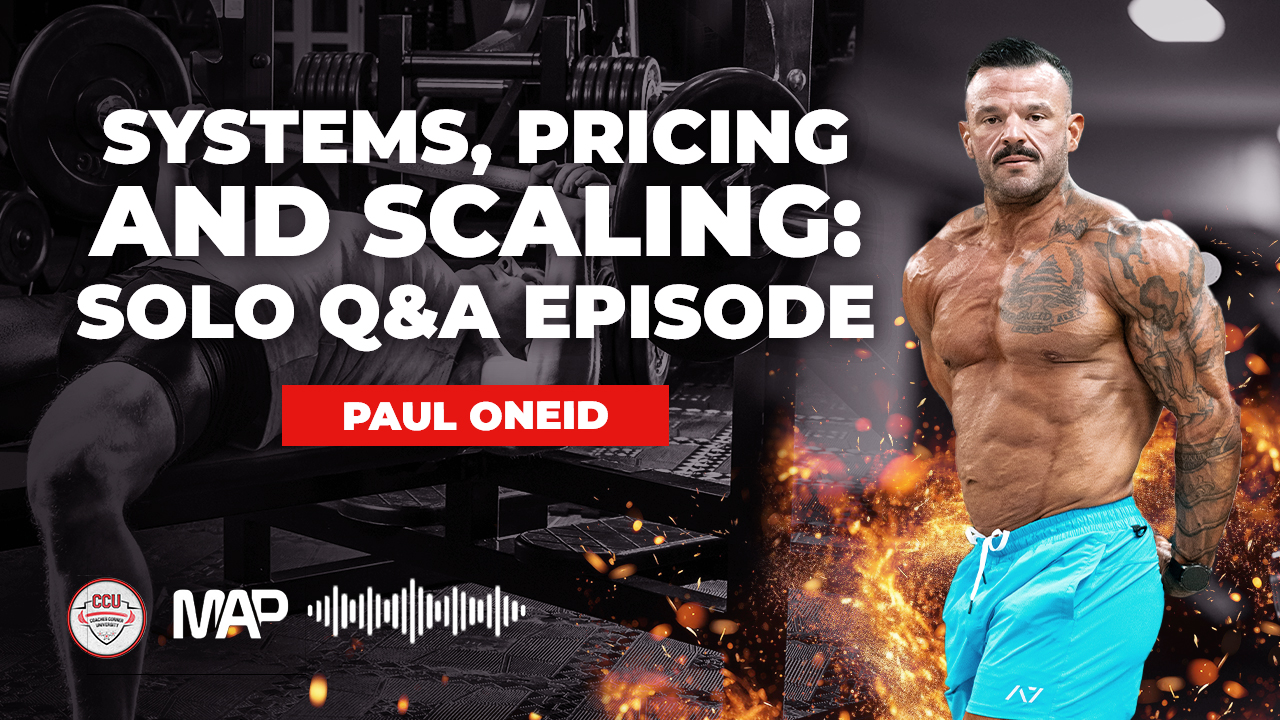
CCU Podcast - Systems, Pricing and Scaling: Solo Q&A with Paul Oneid
Systems, Pricing and Scaling: Solo Q&A Episode
Podcast
Paul Oneid -Systems, Pricing and Scaling: Solo Q&A Episode
Today, I come to you with a rare, but soon-to-be-more-regular, solo Q&A episode of the podcast, where I tackle the five most common questions I get from coaches every week. These aren't theoretical problems. They're the real struggles that keep coaches stuck, spinning their wheels, and wondering why they know what to do but can't seem to do it consistently.
I break down each question with the same systematic approach I've used to build a $750k coaching business while training 16 times a week and running multiple companies. No fluff, no overnight solutions—just the frameworks that work when you put in the work.
10 Key Takeaways from Systems, Pricing and Scaling: Solo Q&A Episode
The Gap Between Knowing and Doing
I address the most common struggle coaches face: knowing exactly what they should be doing but not doing it. The problem isn't discipline. It's that coaches are trying to do too much at once without systems to implement each task in its appropriate vertical. Content creation needs content pillars—four to five big topics with subtopics underneath. From there, it's just throwing a dart and making the video. The solution is booking appointments with yourself. Five hours a week dedicated to content: some for brainstorming, some for scripting, some for filming. Most of my content is filmed while doing things I already do—cardio, training, at my desk—making it authentic to who I am and what I do daily.
Lead Management Is Not Optional
I don't mince words here: if you can't keep track of your leads, you won't make money. The system is simple. Book 20 minutes at the end of every day to update an Excel spreadsheet with every lead—who contacted you, where they contacted you, what the outcome was, and when to follow up. Then in that same 20 minutes, check your spreadsheet and follow up with the people who need it. Meetings in your schedule and living by your calendar is a surefire way to be more productive. If you book a call with a client, you're not going to miss it. You're not going to be late. Why don't you make that same promise to yourself?
Grinding Is a Red Flag
When I hear someone say they're "just grinding right now," it's a clear indication they have no idea to what end they're working and no systems for time management. You can only grind for so long—work relentlessly hard with no structure or no end goal—before you fall off completely. The solution is making a schedule that includes everything you need to do in a week, with appropriate time allocated. Bookend all appointments with check-in sessions. Have flex periods after work periods to assess productivity. Track engagement at the top of the funnel, communication in the middle, and sales calls at the bottom. Based on those ratios, you determine where to allocate more energy.
The Hybrid Practice Model
For personal trainers stuck trading time for money, I introduce the hybrid practice. When you're a personal trainer, you're being paid for the time you spend with the client—nothing more, nothing less. But many trainers provide services outside those hours without compensation. The hybrid model charges a monthly recurring fee for access to programming and nutrition outside the in-person hours. This gives clients autonomy to train when you're not there, provides you with oversight through video submissions, and allows you to impact the other 23 hours in the day when they're not with you. For the client, it's a tremendous added value. For you, it's a way to scale income without adding time to your schedule.
Price Increases Require Value Increases
I'm adamant that any price increase must always be accompanied by an improvement in service quality. This could mean adding features, increasing access, reducing friction, implementing community features, changing check-in frequency, or providing more educational resources. Educational resources also decrease your time because you spend less time answering the same questions repeatedly. A system that solves a problem, frees up time, and adds value for the client is the gold standard. When you pair a price increase with a service increase, it's much easier for clients to swallow because they see they're getting more.
The Grandfathered Rate Strategy
I act in good faith toward those who trust me. When I roll out price increases, they're for new clients first. Existing clients get a grandfathered rate. A few years ago, I raised rates from $400 to $525 per month when transitioning to an app with new community features and monthly calls. New clients paid $525. Existing clients were offered $475—still an increase, but not as steep. The key is to communicate the value adds first, then explain the new rate structure. This approach respects loyalty while still allowing you to increase revenue. If you're increasing prices by 25% and don't lose 25% of your clients—which you won't if done properly—you net neutralize your money and save time.
Scaling Without Fundamentals Is Suicide
I'm blunt about this: you will not be able to grow sustainably without strong fundamentals in place. You'll run yourself into the ground, work more hours, and ultimately make less money per hour. Until you have a comfortable roster of one-on-one clients that is sustainable over time, have done the work to improve service quality and efficiency, and are charging a price in line with the value you add, then you can look to scale. But if you don't have those fundamentals in place, scaling will absolutely ruin your life. The fundamentals are the base of the pyramid. If you don't have them, you can't grow.
Buy Back Your Time
One of the best strategies for scaling is hiring a virtual assistant. Yes, it costs about $1,000 a month. But if that $1,000 gives you back 10 hours a week, how much money could you make in those 10 hours? You're essentially paying someone $250 a week for 10 hours of your time. You're making more than $25 an hour providing your services. The trade-off makes sense. I recommend Dan Martell's bookBuy Back Your Time,and I'll tell you that hiring my first virtual assistant was phenomenal. Word from the wise: if you free up 10 hours a week, only use five for business. Take the other five for yourself.
You Don't Have to Burn It Down
I've never had to blow things up and start over because when I started, I knew what I wanted to do. As my life changed and my personal growth developed, the type of client I coach changed—because you get back what you put out. If your clients drain you and your content feels fake, it's probably because you're not being yourself. Your personal values aren't in alignment with how you've operated your business. You're probably not charging enough, so client quality is low. You don't have to blow things up. You need to figure out who you are, what you stand for, and who you want to coach. Then start being yourself. You'll start to attract people who fill your cup.
Moving Meaningfully Towards a Goal
The difference between doing hard things that make you stronger versus being a workaholic headed for burnout comes down to one thing: moving meaningfully towards a goal. Burnout occurs when there's a gap between the work you're doing and where you want to go. Happiness is moving towards a goal meaningfully. When you have a strong why, you can tolerate any how. It's easy for me to wake up at 4 am or sit at my desk at 9 pm recording a podcast because I'm working hard towards a goal. I'm not burning out. Burnout happens when you don't have a clearly defined goal, and you're just working for the sake of work. That's being in a hamster wheel. When there's meaning in the work, there's way less friction.
I packed a ton of actionable systems into this solo episode. These aren't theories. They're the frameworks I've used to build a sustainable coaching business while maintaining my training, my marriage, and my sanity.
If you're spinning your wheels on any of these five questions, the solution isn't motivation. Its systems. It's clarity. It's doing the work to figure out what you actually want and then structuring your business to get you there. I've been through the burnout twice. I know what it looks like when you're grinding without meaning. And I know what it feels like to wake up at 4 a.m., excited to work because the work matters. The difference is having the fundamentals in place and moving meaningfully towards a goal.
Support the podcast:
Sponsors:
•Next Level Strength Co (Code: ONEID):https://nextlevelstrength.shop/
•X-Factor Labs (Code: ONEID):https://xfactorlabs.in/
•TC Nutrition (Code: TCxONEID):https://tc-nutrition.com/
•Bearfoot Shoes (Code: ONEID):https://bearfoot.store/
Websites:
•Master Athletic Performance (Coaching):www.masterathletic.com
•Coaches Corner U (Mentorship & Education):www.coachescorneru.com
Newsletters:
•MAP Newsletter:https://masterathletic.com/newsletter824861
•CCU Newsletter:https://coachescorneru.com/newsletter-4569
Socials:
•Instagram:https://www.instagram.com/pauloneid/
•Facebook:https://www.facebook.com/paul.oneid.5
•LinkedIn:https://www.linkedin.com/in/paul-oneid-a92b64113/
Find the Podcast


Coaches Corner PhD
Get 1-on-1 mentorship with one of the best coaches in the industry!